Who owns your website? The domain, the hosting and the code
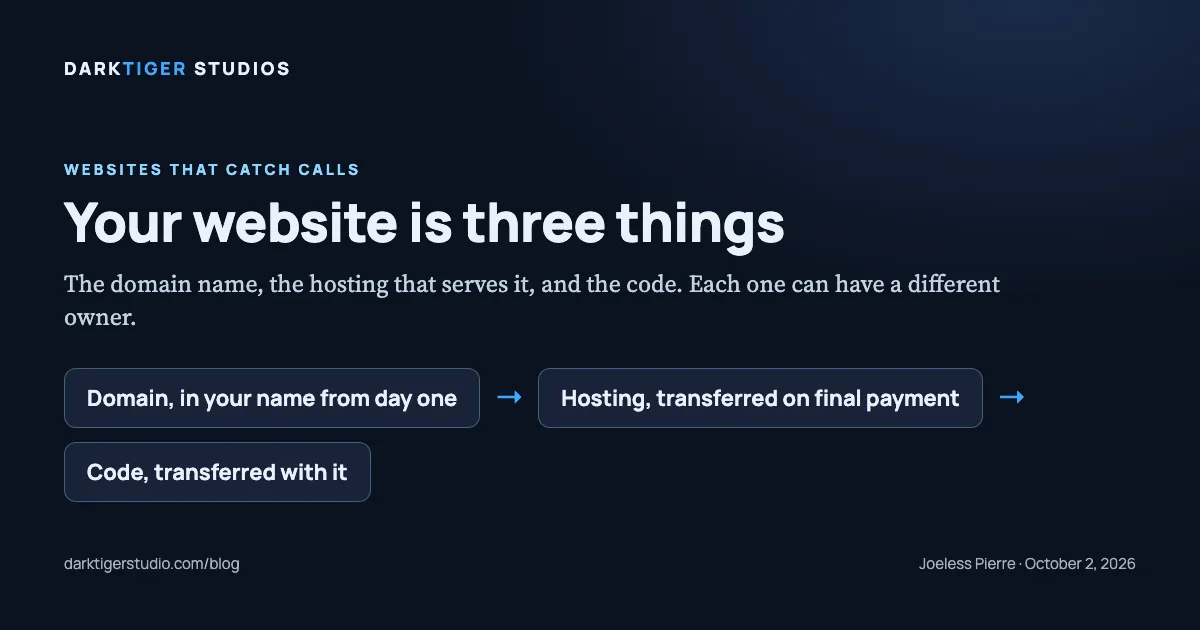
Your website is three things with three possible owners: the domain name people type, the hosting that serves the pages, and the code that is the pages. You can own all three. You should at minimum own the first, because it is the only one that cannot be rebuilt somewhere else.
The domain
The domain is the address. Whoever is listed as its registrant controls where it points, and that person can move it to another registrar at will. ICANN, the body that oversees domain registration, says it plainly: "it is your right to transfer your domain name registrations between registrars" (Source: ICANN). To move it you need a transfer code, which ICANN defines as "a code created by a registrar to help identify the domain name holder and prevent unauthorized transfers," and your registrar "must provide you with the AuthInfo code within five (5) calendar days of your request" (Source: ICANN).
Two timing rules worth knowing. A registrar "may deny a transfer request if the domain name is within 60 days of initial registration," and may also deny one "within 60 days from when you last transferred the domain name to a different registrar" (Source: ICANN). So a domain is a thing you move in weeks, not minutes, which is exactly why it should be in your name before anyone builds a page.
If a designer registered your domain under their own account, you do not own your address. You are borrowing it.
The hosting
Hosting is the service that answers when someone types the address. On a modern host it is a project in an account, and projects can be moved between accounts. Vercel, the host we use, states that "You can transfer projects between your Vercel teams with zero downtime and no workflow interruptions," and lists what moves with the project, including deployments, domains and aliases, environment variables and the Git repository link (Source: Vercel). Other hosts have their own versions of this.
Builder platforms are different in kind. Wix states that "In order for your site to work properly, it needs to be hosted and operated on Wix's servers," while also saying "The content you build on Wix belongs to you" (Source: Wix). Read both sentences together: the words and photos are yours, the site as a working thing is not something you can carry out the door. That is not a trick, it is how a hosted builder works, and it is the trade you make for the convenience.
The code
The code is the pages themselves: the HTML, the styles, the images, the small scripts. On a custom build it lives in a repository, and repositories move between owners with their history intact. GitHub's documentation says a transferred repository keeps its "issues, pull requests, wiki, stars, and watchers," and that "Git information about commits, including contributions, is preserved" (Source: GitHub).
If there is no repository, ask where the code is. "On my laptop" is an answer. It is not ownership.
How to check who owns yours, tonight
- Domain. Look up your domain in ICANN's Registration Data Lookup Tool at lookup.icann.org, or log in to wherever you think it is registered. The registrant should be you or your business. If it is your web designer, that is the first thing to change.
- Hosting. Ask: whose account does the site run in, and can you log in to it? If the answer is a builder platform, the site stays there; make sure the plan and the login are yours.
- Code. Ask for the repository address, or a full copy of the files. If neither exists, you have a site but not the code.
How we do it
Our terms say which of the three you hold and when. Your domain, your Google Business Profile, and your Google Search Console and Analytics are registered in your name from day one. The site itself is built under the studio's hosting and code accounts and transferred to accounts in your name on final payment, or, if you keep a Care Plan, held under the studio and transferred to you at no charge within five business days of your request. If you would rather have your own hosting and code accounts from day one, you say so at scoping and we build there instead. We never hold your passwords; where we work inside an account of yours we do so as a named collaborator you can remove at any time. (Source: DarkTiger Studios terms of service, section 4.)
The reason for the split is practical. The domain is the one thing that takes weeks to recover, so it is yours before work starts. The hosting project and the repository move in minutes, so they move at the end, when the balance is paid and you are happy.
Next step
Do the three checks above. If the domain is not in your name, fix that before anything else, with or without us. If you are planning a new site, every build we quote names which of the three you hold and when, and the site transfers to you. One-page one-page sites start at $1,500; the packages are at /build.
Sources
- ICANN, domain name holder FAQs: the right to transfer, the Auth-Code within five calendar days, the 60-day windows
- Vercel, transferring a project: hosting projects move with deployments and domains, zero downtime
- GitHub, transferring a repository: code repositories transfer with their history
- Wix, exporting or embedding your site elsewhere: a builder site must stay on the builder's servers
- DarkTiger Studios terms of service, section 4: the studio's ownership and transfer terms