Why "page one guaranteed" is a red flag
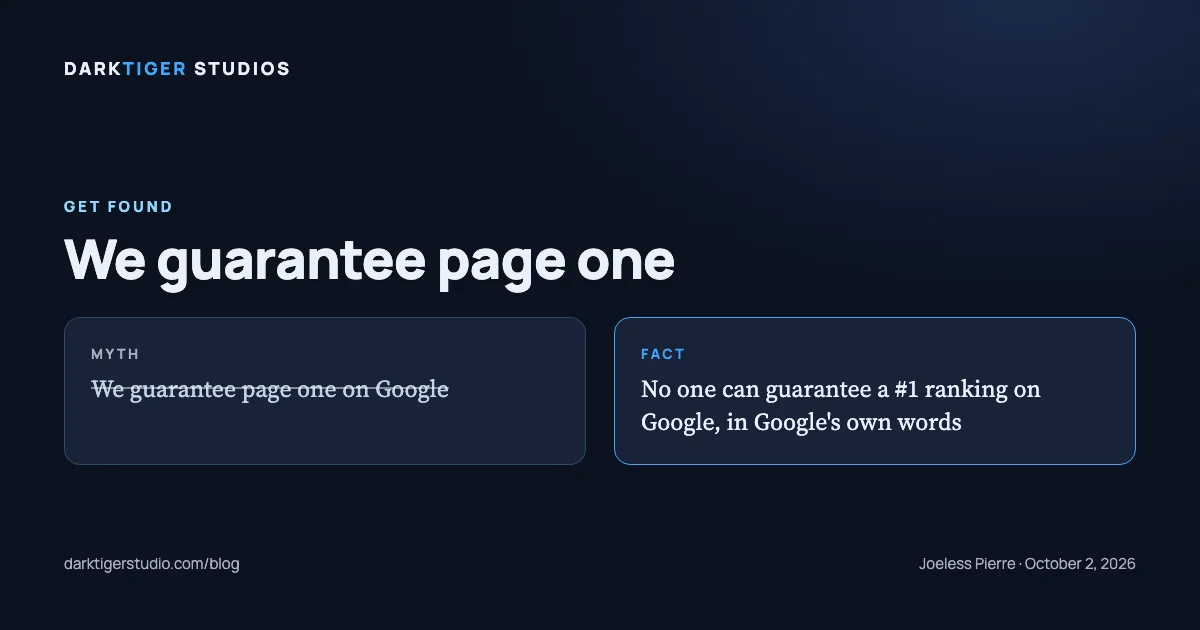
"Page one guaranteed" is a red flag because Google says, in its own documentation for business owners, "No one can guarantee a #1 ranking on Google." (Source: Google Search Central.) A firm that promises it anyway is either guessing, planning to do something Google's spam policies forbid, or guaranteeing page one for a search nobody types. Sometimes all three.
Google's words, not ours
The page is called "Do you need an SEO?" and it is written for people exactly like you, deciding whether to hire someone. It tells you to be wary of firms that claim to guarantee rankings, that allege a special relationship with Google, or that advertise priority submission. It also lists warning signs: unsolicited emails offering search services, firms that are "secretive or won't clearly explain what they intend to do," and firms promoting "link popularity schemes or submitting your site to thousands of search engines" (Source: Google Search Central). Then it adds the line that should end the conversation: you are responsible for what a firm you hire does to your site.
On the money side, Google's own explanation of how it ranks results says: "We never provide special treatment to advertisers in how our search algorithms rank their websites, and nobody can pay us to do so." (Source: Google, How Search Works.) So the one thing that would make a guarantee possible, a price list, does not exist.
Why the promise is empty
Three reasons, none of them clever.
Google decides, and it keeps changing its mind. Google's own starter guide says of changes you make: "Some changes might take effect in a few hours, others could take several months," and advises that "you likely want to wait a few weeks to assess whether your work had beneficial effects" (Source: Google Search Central). Anyone who guarantees an outcome on a timeline is guaranteeing something they do not control.
Your competitors are also on the internet. Page one for "plumber Albany NY" has a fixed number of organic spots and more plumbers than spots. A guarantee to one of them is a guarantee against all the others, and the firm selling it is often selling the same promise to two of them.
The guarantee is usually for a different search. "Page one for your business name" is easy; you are the only one with that name. "Page one for a 14-word phrase" is easy because nobody searches it. Ask which exact search is guaranteed, then type it into Google yourself and look at who is there now.
What the promise usually hides
When a firm cannot earn a ranking honestly, the shortcut is almost always one of two things Google names as spam.
Bought links. Google: "Link spam is the practice of creating links to or from a site primarily for the purpose of manipulating search rankings," and "Buying or selling links for ranking purposes" is on the list, including "Exchanging money for links, or posts that contain links." (Source: Google Search Central, spam policies.)
Mass-produced pages. Google: "Scaled content abuse is when many pages are generated for the primary purpose of manipulating search rankings and not helping users," which names "Using generative AI tools or other similar tools to generate many pages without adding value for users" (Source: Google Search Central, spam policies).
Both can produce a short-term bump. Both are done to your domain, in your name, and the responsibility sentence from Google's page applies to you, not to the firm that has moved on to the next plumber.
What to ask instead
Google supplies the questions. Among them: "Can you show me examples of your previous work and share some success stories?", "Do you follow the Google Search Essentials (previously known as Webmaster Guidelines)?", "What kind of results do you expect to see, and in what timeframe?", "How do you measure your success?" and "How long have you been in business?" (Source: Google Search Central.) A firm that answers the timeframe question with "guaranteed" has failed the test Google wrote.
What we promise, and what we do not
Our terms say it in one sentence: "We do not promise search rankings, lead counts, revenue, or that any AI assistant will cite you; those depend on search engines, AI companies and your market, not on the site alone." (Source: DarkTiger Studios terms, section 5.)
What we do promise is the work, measured. Search and AI Foundations, $650, is a fixed list: LocalBusiness, Service and FAQ structured data on the site; an answer page written from the questions customers actually ask; your Google Business Profile completed with categories, services, hours, photos and Q&A; AI crawler access set in robots.txt plus an llms.txt file; Search Console verified, sitemap submitted, indexing confirmed; and a before-and-after report on every item. Google's starter guide says "Creating content that people find compelling and useful will likely influence your website's presence in search results more than any of the other suggestions" (Source: Google Search Central), which is why the answer page is on the list and a guarantee is not.
Where you land after that is Google's decision. Anyone who tells you otherwise is quoting a page that does not exist.
Next step
If a quote on your desk includes a ranking guarantee, ask for the exact search phrase and the method, in writing, then read Google's page. If you would rather buy the foundations and a measurement, the list above and the price are at /services#aeo.
Sources
- Google Search Central, do you need an SEO: no one can guarantee a number one ranking; the warning signs; the questions to ask
- Google, How Search Works, ranking results: nobody can pay Google for ranking
- Google Search Central, spam policies: link spam and scaled content abuse
- Google Search Central, SEO starter guide: changes take hours to months; useful content matters most
- DarkTiger Studios terms of service: what the studio does and does not promise